

A decade ago, the entire global secondary market transacted less in a year than a single flagship buyout fund raised at a final close. In 2025, secondary volume crossed $225 billion. Scale alone doesn't make something an asset class — equity crowdfunding is big too. The blow outlines why we think the secondary market has crossed the threshold from a tactical liquidity tool embedded inside private equity into a standalone asset class with its own return drivers, its own infrastructure, and its own line item on the allocator's page.
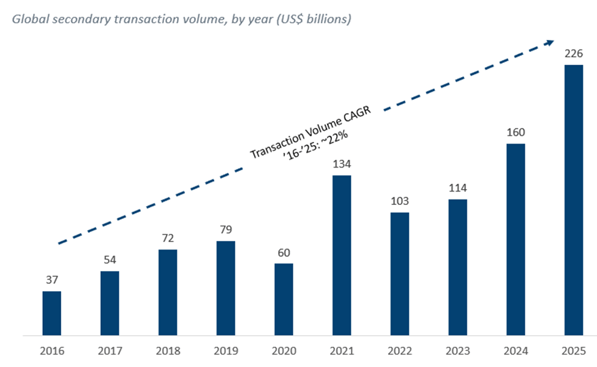
Source: Evercore 2025 Survey
What "asset class" actually means
The label gets thrown around loosely in finance. We'd argue it rests on four tests. First, scale — the market has to be deep enough that institutional allocations can be deployed without moving prices. Second, a distinct return profile — economics that aren't just a slightly-offset copy of the underlying. Third, institutional infrastructure — dedicated managers, advisors, trade press, benchmarks, a body of research. Fourth, allocator behavior — LPs actually treating the strategy as its own line item, with its own pacing model, rather than folding it into "private equity."
By each of these tests, secondaries used to fail. Today it passes all four. Here's the evidence.
The four tests, scored in 2026
Scale. The transaction volume figure tells part of the story; dry powder tells the other part. Dedicated secondaries funds held an estimated $200+ billion in callable capital entering 2026 (with another ~$100bn+ out in fundraising), with record single-fund closings at Ardian, Lexington, Blackstone Strategic Partners, HarbourVest, and Goldman Sachs Vintage over the past eighteen months. The buy-side has kept pace with the market demand for liquidity.
Return profile. Secondaries economics differ from primary private equity in ways that matter to a portfolio. Shorter duration, because you're buying into funds already three to seven years into their life. Earlier DPI, because distributions arrive sooner. Tighter IRR dispersion across managers, because you're often buying a basket of underlying GPs and vintages in a single commitment. The academic work — Nadauld, Sensoy, Vorkink and Weisbach (Journal of Financial Economics, 2019) — quantified the liquidity discount buyers have historically captured, though that discount has compressed as the market has matured.
Infrastructure. A full ecosystem now surrounds the market. Advisors at Jefferies, Lazard, Evercore, PJT Park Hill, Campbell Lutyens, Cebile/Raymond James, and Mizuho/Greenhill publish semi-annual market reports that function as the reference data for the industry. Secondaries Investor covers the market daily. ILPA's 2023 guidance on GP-led secondaries gave LPACs a standard framework for handling conflicts and consent. Dedicated benchmarks, while still less refined than their primary PE counterparts, are emerging.
Allocator behavior. Pensions, sovereigns, and insurers increasingly carve out standalone secondaries sleeves with their own pacing models, separate from their primary PE programs. Evergreen vehicles from Partners Group, Hamilton Lane, Ares, StepStone, and Blackstone have opened the strategy to wealth channels at meaningful scale. The "sidecar" framing is already gone at the largest institutions.
| Asset Class Test | Secondaries in 2010 | Secondaries in 2026 |
| Scale | opportunistic transactions | Health split of repeat sellers and new entrants |
| Return Profile | Unproven | Reduces J-curve impact, tigher IRR dispersion when compared to traditional BO |
| Infrastructure | Few firms of scale | Advisor, buyer and seller network all built out |
| Allocator Behavior | Treated as a "last resort" | Strategic buyers/sellers as part of healthy portfolio management |
Why now: three structural tailwinds
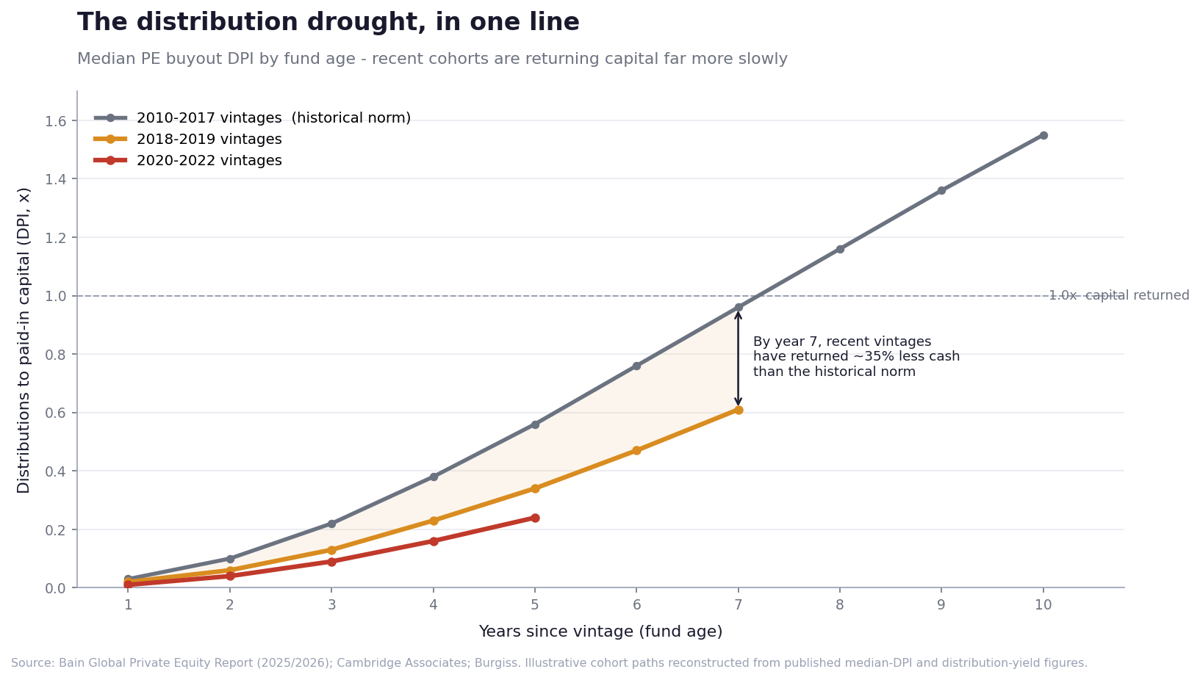
Distribution drought meets DPI mandate. Private equity distributions have run well below historical averages for three years running (12% compared to historical average of 20-25%). LPs need liquidity; GPs face re-up pressure from LPs who have received less cash than their pacing models assumed. Secondaries is the pressure valve on both sides, and it gets pressed harder the longer the drought continues.
GP-led normalization. The continuation vehicle has moved from a workaround for troubled assets into a standard portfolio management tool for high-quality ones. Two deals anchor the shift. Hg's Saturn series — where high-performing software platforms were moved into dedicated continuation vehicles rather than exited to the next sponsor — showed that CVs could be used to hold winners, not hide losers. Leonard Green's multi-asset continuation vehicle for LGP VI demonstrated that the same logic could be applied to a diversified portfolio, not just a single trophy asset. Between them, they reset the market's default assumption about what a GP-led is for. LPAC muscle memory has developed in parallel; ILPA has published guidance; advisors have built dedicated GP-led practices.
Structurally permanent buyers. Insurance capital and wealth-channel evergreens are not cyclical. Insurers are drawn to secondaries for the shorter duration and clearer cash flow profile against their liability books. Evergreens solve the allocator access problem in the wealth channel. Together they represent a new, structural layer of demand that didn't exist at the last peak. This is what separates 2024–2026 from the 2020 rebound: the demand is structural, not cyclical.
What secondaries is not
Credibility requires being honest about what the label doesn't buy you. Secondaries is not liquid in the retail sense of the word — settlement takes months, transfer approvals add friction, and the underlying funds remain private. It is not an alternatives hedge — in a broad private markets drawdown, secondary pricing moves with everything else, as 2022 reminded the market. And it is not a monolith — tail-end LP portfolios, high-quality mid-life LP stakes, single-asset continuation vehicles, multi-asset CVs, and preferred equity are as different from one another as LBO is from growth equity. Treating "secondaries exposure" as a single check-box is already an outdated mental model.
Where it fits in a portfolio
Three framings we see allocators using today. First, as a liquidity and pacing tool within an existing private equity program — to manage J-curve, vintage concentration, or specific manager over-weights. Second, as a standalone allocation, which is increasingly the default for institutional programs above roughly $5 billion in private markets AUM. Third, as an entry point for first-time private markets investors — evergreens are making a reasonable version of the strategy accessible to allocators who wouldn't have committed to a traditional closed-end fund.
The frame, and what comes next
Calling secondaries an asset class in its own right isn't a marketing claim; it's where the evidence has moved. Over the coming posts we'll get into the mechanics — how pricing and structuring interact, how a secondary deal's cash flows layer across its life, and where the risks hide. Consider this the frame. The work is in the details.
Further reading
- Bain — Welcome to a New Era in Private Equity (GPER 2026)
- Bain — Global Private Equity Report 2025
- PipelineRoad — PE Returns Statistics 2026 (Cambridge/Burgiss DPI by vintage)
- UpLevered — PE DPI benchmarks by vintage age
- Jefferies, Global Secondary Market Review (H1 2025)
- Lazard, Secondary Market Report
- Evercore, Secondary Market Survey
- Coller Capital, Global Private Capital Barometer
- ILPA, Guidance for LPs: GP-led Secondary Fund Restructurings (2023)
- Nadauld, Sensoy, Vorkink & Weisbach, "The Liquidity Cost of Private Equity Investments: Evidence from Secondary Market Transactions," Journal of Financial Economics (2019)